
.svg)
OpenClaw in Minutes?
OpenClaw has taken the world by storm and is indeed incredibly powerful, but the setup is still non‑trivial. For many people, the combination of CLI, VPS/Docker, API keys, and skills configuration presents enough friction that they never get past successfully running one or two basic agents. But the real magic of an agentic AI system happens when you run many AI agents instead of just a few.

If you’re only running one or two AI agents, you’re not really building an AI system — you’re just giving a chatbot extra work and the experience will often feel not a whole lot different from a chatbot like ChatGPT.
Most people’s first experience with agents looks like this:
- A general-purpose assistant wired into tools.
- Maybe some scripts around it.
- A lot of manual glue to keep it running.
Agentic AI is incredibly powerful tech, but it’s currently quite fragile, hard to scale, difficult to set up, and requires a host. Every new workflow feels like undertaking a minor engineering project. In addition, singular all-purpose agents can be prone to hallucinations, so people stop at one or two agents and assume that’s the ceiling.
The reality is almost the opposite: intelligence gets interesting when you add more agents (Minds), not fewer. The trick is making it easy enough that you want to spin up many agents instead of just a few.
Why you need many Minds, not one super agent
Think of an organization. You don’t hire one genius to run product, sales, legal, finance, and support. You build a team. Each person on the team has a role, a context, a history with you.
AI works the same way:
- A single, do‑everything agent is simple to imagine but messy in practice: too much context, too many responsibilities, and no clean way to separate concerns.
- Multiple specialized agents — each with a narrow job and limited memory — are easier to reason with, easier to trust, and easier to improve.
You might have:
- One agent that only reads your dashboards and flags anomalies.
- One that only drafts copy.
- One that only does research.
- One that only checks risk and compliance.
Individually, they’re “small.” Together, they form networked intelligence — a system where value emerges from how they interact, hand off, and correct each other.
Peter Steinberger, the creator of OpenClaw runs up to 10 agents simultaneously just for coding!
The problem today: available tools make multi‑agent hard
Most current stacks weren’t designed for normal people to run 10, 20, or 50 agents.
You run into problems like:
- Every agent needs custom setup, configuration, and hosting.
- Sharing memory and context between them is painful.
- Observability and control are scattered across scripts and dashboards.
So even if you believe in multi‑agent systems, the friction quietly pushes you back to: “Let’s just make one really big agent and hope it can do everything."
We built Animoca Minds to eliminate the difficulty of setting up and running agentic AI, with a particular focus on multi-agent AI setups.
Posts that say they can run Openclaw in minutes are clickbait, because most setups require several hours or many days to get running. Experienced AI expert Wyndo has described the situation thus:
This isn’t like downloading an app, tapping through a few screens, and having it work in five minutes. There’s no polished UI guiding you through each step. No “click here, done, move on.” The setup lives in the terminal. It requires debugging, sometimes for hours. And if something breaks, you’re not hitting a support button. You’re reading error logs and Googling your way through it.
I hit walls. Multiple times. Things that felt like they should just work didn’t. And I’m someone who’s comfortable in this space. For someone who’s never self-hosted anything before, or doesn’t enjoy spending their evening reading documentation? This is going to feel clunky. I’m not going to sugarcoat that.
Right now, OpenClaw feels built by developers, for developers. The power is there — honestly, it’s so good. That’s why I’m taking this risk and can’t just ignore this cool new toy. But the experience of getting to that power hasn’t caught up yet.
Where Animoca Minds comes in
Animoca Minds starts from a simple idea: in order to run multiple agents you really shouldn’t have to be a one-person infra team. You should be able to do it in just a few minutes.
Instead of thinking, “How do I wire another tool to my one assistant?” or “How do I set up this VPS correctly?” you can simply ask yourself, “What new Mind do I need in my network to help me make something amazing or useful?” And then accomplish it easily and quickly, without friction.
With Animoca Minds:
- You create persistent Minds — AI agents with their own identity, memory, and role.
- Each Mind can specialize: research, community, operations, content, data, and much more.
- All the Minds sit on shared rails for identity, data, and can also handle on‑chain assets and incentives.
Setup and operation of Animoca Minds happens simply and quickly via email conversations. After the initial setup, you can also connect with your Minds on Telegram, if you prefer.
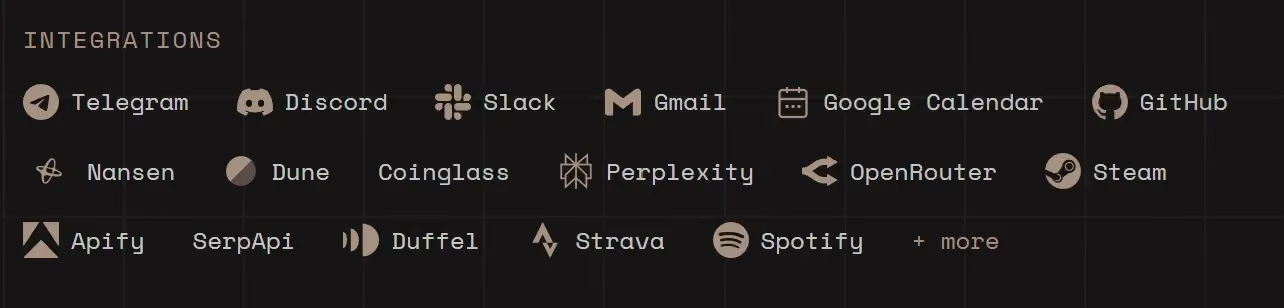
This streamlined approach makes it natural to create and maintain multiple Minds:
- Need a new workflow? Spin up a new Mind instead of overloading an old one.
- Need regional nuance, a specific brand voice, or a domain expert? Give that task its own dedicated Mind.
- Need to experiment? Clone a Mind, tweak it, and see how it behaves alongside the others.
- Mind doesn’t do what you want? No problem, retire it and spin up a new one — the cost is nothing more than a few minutes of time!
Animoca Minds is a platform that handles the heavy lifting — persistence, coordination patterns, safe access — so that adding more agents is no longer an engineering task, it’s a basic product and workflow decision.

Networked and emergent intelligence, in practice
Once you have several Animoca Minds running, you start to see emergent behavior:
- A market‑watching Mind surfaces signals.
- A strategy Mind filters those signals looking for what matches your goals.
- A content Mind turns that into finished communications for your community or partners.
- A governance or risk Mind that pushes back when something misaligns with your rules or reputation.
No single agent knows everything, but the network behaves intelligently: it debates, filters, and refines before anything reaches you or your users.
This is the real shift:
- Intelligence stops being about what one big AI model can do.
- Intelligence becomes focused on what a network of Minds can do together.
- The Minds can perceive, talk, agree and disagree among each other to exhibit emergent network intelligence, and all of this activity is observable to the human operator.
This is the power that people clearly see in OpenClaw, but in order to implement OpenClaw successfully you have to be a developer or just really knowledgeable. Animoca Minds enables anyone of any ability level to experience the power of agentic AI within minutes.
Experience it for yourself at http://www.animocaminds.ai. It’s incredibly easy to get started!

Yat Siu
Co-Founder and Executive Chairman
Animoca Brands
A version of this piece was first published on 11 March 2026 at https://ysiu.medium.com/openclaw-in-minutes-631adfd879f5