
.svg)
Sovereign Multitude: The Internet After Users
Why the future of the web belongs to autonomous AI agents and what that means for your job description
Throughout the internet's history, its fundamental design principle has centered on the human user: clicks, feeds, forms, inboxes, dashboards, notifications. For more than thirty years, the User Experience (UX) has been the undisputed model for defining our digital interfaces throughout the Web1, Web2, and Web3 eras. But that model is starting to break.
A new interface layer between people and the web is emerging. That new layer is the autonomous AI agent: not a chatbot, not a copilot, but a persistent, goal-directed software entity that can perceive context, make decisions, act across tools and platforms, and coordinate with other systems to achieve outcomes that you define, but don't have to execute yourself.
Unlike the many evolutions of the web since its creation in the 1990s, the new agentic interface layer that is emerging is not so much an incremental change as a major architectural shift.
Very simply, the nature of the shift is this: the primary actors on the internet are no longer guaranteed to be humans interacting with apps such as web browsers or other software. The internet’s primary demographic will not be humans.
The internet is becoming the playground of networked autonomous intelligences acting on humans’ behalf—searching, negotiating, transacting, composing workflows, and collaborating across services at machine speed. We are entering the 'post-user' internet, where the dominant actors are not people browsing apps, but autonomous intelligences acting on our behalf.
This is not a hypothetical prediction: there is an ongoing structural change in how the web is being built, monetized, and navigated. It is happening right now and it changes everything we thought we knew about how to build products, organize teams, and define jobs.
From User Experience to Agent Experience
The last three decades of the web have been dominated by user experience, or UX. The next decade will be shaped by agent experience, or AX.
Products that cannot be discovered, interpreted, and acted upon by an agent will tend to disappear from the flow of value creation. This is not because humans will no longer matter – it is actually the opposite: human intent will be more important than ever because it will increasingly be expressed through (and amplified by) software proxies that operate continuously and at scale.
The shift to agentic AI is forcing a rethinking of how products are built. Interfaces will still matter, but APIs, permissions, memory, trust, provenance, and execution environments will matter even more. The primary focus is shifting from designing “screens" for humans to designing systems of delegation.
That means that successful software products and platforms will not only look and feel intuitive to us humans, but will also be architected for autonomous agency, coordination, human-defined constraints, and machine-readable trust.
From Push to Pull
In simplified terms, much of the evolution of the modern consumer internet has occurred on the “push” model: a server sends data as soon as available, and the user receives the data automatically. The internet does use “pull” extensively (most notably, HTTP is based on request-response), but much of the activity in our daily routines is push-based: emails are pushed into inboxes, notifications are pushed to phones, ads are pushed into feeds. The result is that software demands our attention constantly in some way or another.
AI agents completely invert this dynamic of the web.
Instead of humans being repeatedly interrupted to process information, agents can pull what matters from the network, filter noise, prioritize relevance, and execute actions when thresholds are met.
In the world that is taking shape around us (right now), today’s inbox UX strategies will start to look like artifacts from a less intelligent era.
Push-based technology such as email or instant messaging apps won’t disappear, but its role will change. What was once a communication layer between people is becoming a substrate that agents parse, triage, summarize, and convert into decisions or workflows. Your agent can automatically read and act on your behalf in your traditional human communications.
The shift is not just automation, it's the relocation of attention. When agents become the active layer pulling signals from the web, humans can spend more time on judgment, strategy, creativity, and all the other things that actually require being human. By transforming the internet from a 'push' ecosystem of interruptions into a 'pull' substrate of relevance, agents will reclaim our most over-farmed resource: human attention.
One Agent Is Not Enough
In every technology cycle there is a strong temptation to believe in the single universal interface – for example, one device, one model, one assistant, one operating system for everything. But production heavily favors specialization.
Although AI general frameworks are useful, a single, generalist AI serving multiple complex and disparate fields is likely to produce diluted or inefficient output. On the other hand, specialist agents working together are able to work in parallel and perform very effectively with relatively narrow but deep expertise fine-tuned to domain-specific data, precisely architected for each target system.
One agent can be exceptional at planning, another at retrieval, another at compliance, another at execution, and another at negotiation. When specialist agents collaborate, they generate high-quality outcomes through a strategic division of labor, parallel processing, and a collective mechanism for intercepting and rectifying errors.
Coordinated squads of agents with bounded competence and defined responsibility are capable of working together in a well-structured team. The power of this approach can be readily observed in products such as Claude Cowork, which maintain a generalist framework for user interaction but launch specialized agents ad hoc to complete tasks. While ad-hoc agents provide some of the awesome power of multi-agent setups, they lack persistence.
Persistent agents are generally superior for tasks that are complex, long-running, and stateful (requiring context and history). A persistent agent is able to retain memory, context, and configurations across multiple interactions, allowing it to learn and improve itself with every task it performs.
This is where the real complexity kicks in. When multiple persistent agents collaborate, you need routing, accountability, memory synchronization, protocol standards, and conflict resolution. That’s why protocols and tools for agent-to-agent communication—such as MCP, A2A, ACP, ANP—are emerging: the internet needs a common language for software entities that must coordinate, discover capabilities, and exchange intent across platforms.
Blockchain: The Economic Layer
There is a particular point when much of discourse about AI tends to stop short: nearly everyone talks about agents performing tasks, but very few talk about agents owning things.
If agents are going to make necessary economic transactions—pay for computing power, acquire data, compensate other agents for completed work, settle fees, manage capital—then they need a native way to hold value, transfer value, prove ownership, and settle with other agents without a human gatekeeper in the loop.
Blockchain is not merely an option; it is the essential legal and economic substrate for machine-native commerce. In order to serve us effectively, agents require:
- Wallets
- Programmable assets
- Digital Identity
- Escrow
- Payment rails
- Reputation
- Verifiable transaction history
These requirements are easily met on blockchain. A cryptographic token can represent payment, access, stake, permission, reputation, governance rights, and/or participation in a network, which makes crypto tokens the ideal native currency for agentic coordination.
Blockchain provides something that traditional web infrastructure does not easily achieve: sovereign transfer of assets. An agent that controls a wallet can receive and disburse funds, pay for services, stake into a protocol, or compensate another agent, all without a centralized intermediary (a person) approving the flow.
With blockchain providing the power to transact natively and autonomously, agents shed their status as mere digital proxies and tools, becoming genuine economic actors.
For example, an agent specializing in graphic design could autonomously commission image generation, pay for dataset access, and compensate a distribution agent—all entirely transacted on-chain. An agent specializing in trading could manage the rebalancing of capital. A logistics agent could settle service fees. A governance agent could vote through tokenized rights. And so on.
Real-World Agentic Commerce
Autonomous agents are already trading crypto on Hyperliquid and buying and selling NFTs on OpenSea, and that is only the beginning.
The logical convergence of autonomous systems and programmable value is no longer a futuristic prediction; it is already in progress. By integrating with blockchain, autonomous agents have transitioned from simple software tools into market participants capable of independent transaction and settlement.
Below are some examples of the agentic economy:
DeFAI (DeFi + AI) and autonomous capital management: Agents operating as decentralized liquidity managers or algorithmic traders. See Virtuals Protocol and Superior Trade.
Infrastructure for sovereign agency: Execution and identity frameworks that empower agents to perform autonomous on-chain actions through agent-native wallets and identity layers. See Trust Wallet Agent Kit, Warden Protocol, and our project Moca Network developing an open user-centric digital identity infrastructure.
Decentralized resource marketplaces: Protocols where agents autonomously trade compute, training data, and specialized logic. See Bittensor and Fetch.ai.
Agentic social networks and reputation: Environments where agents interact to build social signals. Examples include Moltbook, the viral AI-only social network recently acquired by Meta, and research forums such as Harvard’s ClawInstitute where agents critique scientific findings collectively. Our project Moca Network is building a foundational identity and reputation layer for the millions (and eventually billions!) of agents that will navigate and transact across the web.
Agent-to-agent coordination and orchestration: Frameworks designed to manage squads of specialist agents to achieve complex goals. Examples include the Autonolas (Olas) network for off-chain service coordination and our very own Animoca Minds, which allows users to quickly deploy networked agents without any technical setup.
Ownership Becomes Interface
One of the most significant implications of the agentic era is that ownership becomes even more important.
In Web2, users “rented” access inside platforms, paying with their attention (eyeballs). In the agentic web, or Web4, people will need agents under their sovereign control that can act in their interest, maintain their context, and transact their assets. All of that requires trusted ownership over identity, memory, permissions, and economic resources.
Blockchain and tokens provide the architecture for that control because they allow coordination without dependence on a single platform intermediary.
This is why the future of agents cannot be simply AI + chat (as remarkable and impactful as that innovation is). The future must include AI + agency + property rights + programmable markets.
When your agent can own an asset, move it, verify it, and exchange it under transparent rules, the relationship between person and platform changes dramatically. Users are no longer merely sources of data or attention. Instead, users become the principals of multiple intelligent economic extensions of themselves.
Job Descriptions of the Agentic Era
When you have squads of agents ready to work on different tasks, it is essential for someone to manage them effectively in order to achieve their potential. The ability to orchestrate and govern agents therefore becomes a core requirement rather than a technical footnote.
The last technology cycle gave us job titles such as Social Media Manager, Growth Hacker, DevOps Engineer, and UX Researcher—all roles that didn't exist ten years before they became essential.
The agentic era will trigger similar changes, but more quickly. By now you have probably come across the term “vibe coding,” which refers to software development by AI agents, with humans (of any skill level) providing intent and natural language instructions to an agent instead of writing the code themselves.
Consider a few of the agent-focused roles and functions that are already beginning to crystallize around vibe coding or, as Peter Steinberger likes to call it, agentic engineering:
Agentic AI Designer: doesn't just make things look good, also designs workflows, trust surfaces, and delegation patterns optimized for both humans and autonomous agents.
Agentic AI Engineer: builds the execution layer—memory, tools, permissions, observability, sandboxing—that makes delegation reliable.
Agent Orchestrator: the conductor, managing coordination across squads of agents operating on different tasks, timelines, and resource pools.
Agent Economist: designs the token incentive structures, pricing models, and on-chain payment flows that govern how agents earn, spend, and transfer value.
Agent Governor: defines the constitutional constraints—what an agent can and cannot do, when it must escalate, and how auditability is maintained.
The new agent-focused roles that are emerging are not speculative titles – they map directly to the technical, economic, and organizational challenges of shifting from building for human users to building systems in which autonomous agents have become the primary actors.
The Pattern Persists
Previous tech platform shifts have been accompanied by the rise of their own distinct categories of labourers.
The PC era gave us the IT department. The web gave us web developers and designers. Social media gave us content creators and community managers. Smartphones gave us app developers and growth teams. Cloud gave us DevOps and SRE (site reliability engineering).
As discussed above, the agentic era will see the rise of agentic AI-focused roles such as designers, engineers, orchestrators, economists, governors, and AgentOps teams.
Organizations able to define and hire for these roles will gain an important early advantage in a world where the internet is no longer used primarily by humans but by intelligent systems that act on people’s behalf, hold and manage their assets, and transact on-chain with sovereign economic agency.
The Agent-Native Internet and Human Creativity
Every major internet epoch creates its own native subject. The early web had readers. Social media had users and creators. The mobile era had app-native consumers. Now we have autonomous agents.
This is not an apocalyptic vision. Although AI is causing painful disruptions in the workforce, I do not think that humans will be supplanted en masse by artificial beings. Instead, I think humans will move up the stack: our focus will shift away from performing routine, detailed tasks, and we will instead define goals, constraints, values, and ownership boundaries, while our agents perform discovery, execution, negotiation, and settlement for us.
Today, our creativity is too often weighed down by rigid habits, responsibilities, and conformity. Most of us are forced to prioritize established patterns (like job performance or school work), rather than innovative thinking.
The unfortunate result is that it becomes much harder for us to imagine (or even just see) novel solutions and ideas, despite the fact that we are born into this world equipped with a supremely powerful engine of creativity: the human mind.
Imagination is more important than knowledge. Knowledge is limited. Imagination encircles the world.
- Albert Einstein
I strongly believe that the ability of agents to automate the mundane will dissolve the shackles of our routines, liberating the human mind for a new era of creativity.
Computational Marketplaces
For decades, we used the internet by browsing it manually, and it was great. Now the internet is evolving into something much more powerful: an intelligent and evolving computational marketplace operating on our behalf.
The majority of people are already inside computational marketplaces, such as the popular commerce layers provided by companies like Amazon and Alibaba. One of the most influential computational marketplaces is computational advertising, which is how Alphabet (Google) and Meta (Facebook) generate most of their revenue.
Advertising is driven by the trade of our attention, a commodity which is extracted from us—frequently to our annoyance—through various means and media. But that will change as greater and greater numbers of agents become empowered to act on our behalf.
By serving as software proxies for their human principals, agents will relocate attention and significantly alter the fundamentals of advertising.
As described earlier, your agent will interface with the web for you, consuming information, filtering noise, and reporting items of relevance. Since your agent doesn't care about ads, the traditional ad-supported revenue model starts to break down. Advertisers will need to find ways to reach you through your agent, or convince your agent that their products are valid solutions for you.
In the agentic era, you become the principal and your agents manage your "attention assets" to ensure that you get the most value for them. The computational advertising marketplace evolves from a space where you are a product to be extracted, to a space where your agents are active economic participants searching for the best possible outcomes on your behalf.
The table below summarizes the fundamental shift in how we interact with and derive value from the digital world:
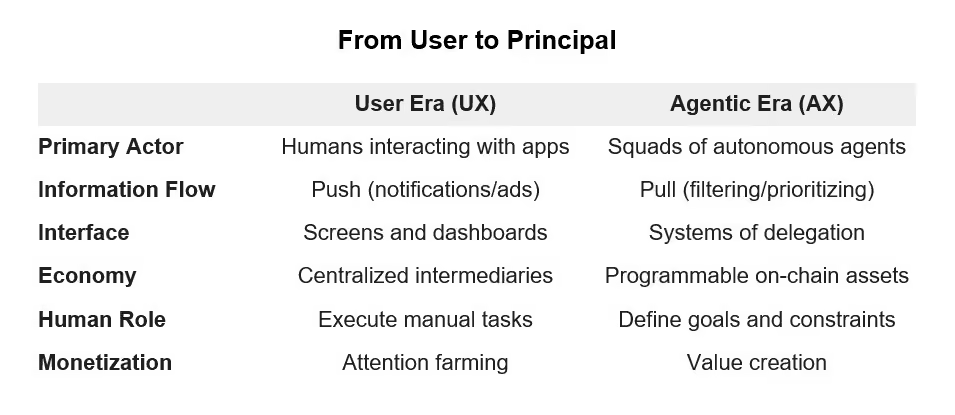
When We Become Multitudes
The rise of agentic AI is causing a shift away from personal user interactions and toward delegation to software proxies. We are no longer interfacing with software in the traditional manner; instead, our agents are starting to operate software for us more quickly and more efficiently than we ever could.
This paradigm shift demands a radical rethinking of the fundamentals of software in particular and information in general. We will no longer design only for human consumption, but will also need to architect for autonomous agency.
The way we assess the value of software is also changing. In addition to asking for standard information such as how many users a platform has, we now need to know how many agents it serves, what permissions they have, what assets they control, what protocols they speak, and what forms of value they can create and exchange.
It’s not just software, of course, and not just about our online experience. The shift to agentic AI has the potential to reshape the value chain of virtually every industry.
We live in a truly remarkable time. At this very moment, each of us possesses the extraordinary ability to become the steward of a multitude of autonomous experts and doers focused entirely on fulfilling our instructions. With just a few key strokes, we can multiply our limited human capabilities virtually instantaneously.
This incredible potential is already available and will become more widespread and accessible in the coming months. Indeed, ease and accessibility are precisely the reasons we are building Animoca Minds: all the power of networked autonomous agents without any setup or special knowledge needed.
I firmly believe that the future of the internet is not just artificial intelligence, but agentic intelligence with economic sovereignty. The people and organizations that understand how to hire, design, build, and govern for this new paradigm—technologically, culturally, and economically—are likely to be the ones who define the next decade.
Yat Siu
Co-Founder and Executive Chairman
Animoca Brands
A version of this piece was first published on 30 March 2026 at https://ysiu.medium.com/sovereign-multitude-the-internet-after-users-fca5f0943e4c